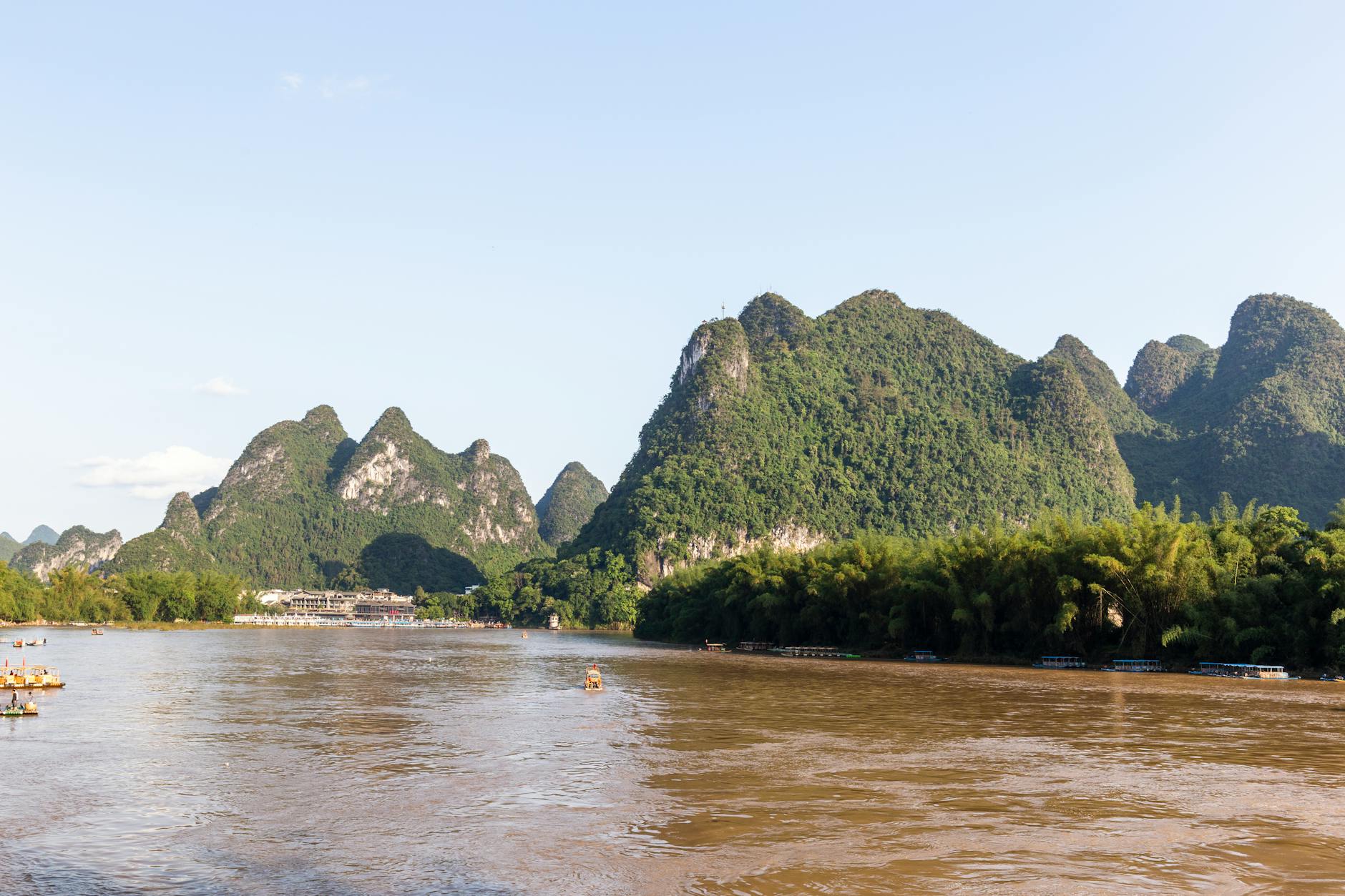
65m karst hill rising directly from the Li River — climb for the river view, see ‘Returning Pearl Cave’ and Tang Buddha carvings.
At a glance
- What it is
- Outdoors
- Also known as
- 伏波山 (Fúbō Shān)
- Opening hours
- 6:30 AM – 6 PM
- Time needed
- 1-1.5 hours
- Best time to visit
- Morning paired with Elephant Trunk Hill
- Getting there
- Metro to the door
- English
- Some English signage
- Cards accepted
- Cash only
- Entry
- Walk-in — no booking
- Wi-Fi
- Free Wi-Fi
- Address
- Binjiang Road, Diecai District, Guilin · 桂林市叠彩区滨江路
Fubo Hill map & getting there
Taxi / DiDi? Show the driver: 桂林市叠彩区滨江路 · Binjiang Road, Diecai District, Guilin
Fubo Hill (‘Subduing Waves’ — named after a Han-dynasty general) is a 65m karst hill rising directly from the Li River bank in central Guilin. It’s smaller than Diecai but more dramatic in placement — the climb gives you a Li-River-from-above perspective rather than Diecai’s full-city panorama. Three named features: Returning Pearl Cave (a stalactite chamber at river level), Test Sword Stone (a hanging rock the local general allegedly cleaved with a sword test), and Thousand-Buddha Rock with 200+ Tang-dynasty Buddhist carvings. Entry ¥22 (cheaper than Diecai). Closer to Elephant Trunk Hill — pair the two as a Li-River-shoreline morning, then Diecai Hill in the afternoon for the city view.
Highlights
- Li River from above65m summit view of the river curving through Guilin
- Returning Pearl CaveStalactite chamber at river level
- Thousand-Buddha Rock200+ Tang-dynasty Buddhist carvings
What Chinese travelers actually do here
Distilled from Chinese-language travel notes — the practical tips most English guides miss.
- Returning Pearl Cave at river level has a famous ‘returning pearl’ stalactite — a pendant of limestone hanging from the ceiling that supposedly returns to its original position if struck. Locals tap it; the stone makes a faint bell sound. Watch but don’t strike — over-tapping accelerates erosion.
- Test Sword Stone is a hanging boulder that appears suspended in mid-air, with a clean cut at the bottom. Photographs well from below the cut. The historical legend (General Fubo cutting it with his sword) is folklore; geologically it’s natural cleaving.
- Fubo Hill is 5 min walk from Diecai Hill and 12 min walk from Elephant Trunk Hill — the three together form Guilin’s ‘central karst’ walking circuit. Visit all three in a morning, then Two Rivers Four Lakes night cruise covers them again from the water.
- Photography: bring a telephoto (70-200mm equivalent) for the Tang Buddha carvings — they’re often 3-5m above eye level and reward close-detail shots. Wide-angle works for summit panoramas.
- Quieter than Diecai or Elephant Trunk — tour groups skip it because the carvings require Buddhist context many guides don’t explain well. Independent travelers benefit from the lighter foot traffic; you’ll often have the Thousand-Buddha Rock to yourself.
- Fubo Hill ticket (¥22) is the cheapest of Guilin’s three central karst hills. Combined with Diecai (¥30) is ¥52 for both — vastly better deal than Sun and Moon Pagodas climb (¥70).
Photos


Watch creators visit Fubo Hill
Each clip is timestamped to the moment the creator arrives at this stop.
China’s most beautiful landscape | Guilin, Yangshuo & The Li River Cruise 🇨🇳
beckonhols 𖤓Starts at 5:40
Fubo Hill scenic area
Frequently asked questions about Fubo Hill
- How does Fubo Hill compare to Diecai Hill?
- Same Guilin city karst hill concept, different angle. Fubo (65m) rises DIRECTLY from the Li River bank — its summit view is dominated by the river below. Diecai (73m) sits inland — its view is dominated by the city panorama. For a complete picture, do both as a 2-hour morning. If only one, Diecai for the bigger panorama.
- Who was ‘Fubo’ (the Subduing-Waves General)?
- Ma Yuan, a Han-dynasty (1st century BCE) general nicknamed ‘Fubo’ (‘subduing waves’) for his successful campaigns to control Guangxi and Guangdong. Local legend says he ‘tested his sword’ against the hanging rock here — the cut visible at Test Sword Stone is supposedly from that historical moment. It’s folklore, but the rock formation is real.
- Is the Thousand-Buddha Rock worth seeing?
- Yes — 200+ Tang-dynasty stone-carved Buddhist statues on a vertical rock face inside the hill. Some are large (1-1.5m tall) with intact features; others are weathered. Photography allowed. About 15-20 min of slow walking covers the rock face. Comparable in scale to Mingyue Cave at nearby Diecai Hill but with different artistic style.
- How long does the visit take?
- 60-90 minutes for the full circuit: Returning Pearl Cave (15 min) → Test Sword Stone (5 min) → Thousand-Buddha Rock (20 min) → summit climb (25 min round-trip). Don’t try to rush below 60 min — you’ll miss the carvings.
- What’s the best photo angle here?
- Summit looking DOWNRIVER (south) gives the Li River curving away with Elephant Trunk Hill visible 2 km downstream — the iconic ‘Li River through Guilin city’ shot. Best at golden hour. Wide-angle 16-35mm equivalent works well for the panoramic curve.
More in Guilin


Plan your Guilin trip
- Guilin vs Zhangjiajie — Which Karst Landscape Should You Pick?Itineraries · 8 min read
- China High-Speed Rail (Gaotie) — The 2026 Foreigner’s GuideTransit · 11 min read
- Does Google Maps Work in China? (No — Here’s What Does, 2026)Internet & Apps · 9 min read
- WeChat Pay for Foreigners — The 2026 Setup GuidePayments · 9 min read
- 240-Hour Visa-Free Transit to China — 2026 GuideVisa & Entry · 11 min read
- How to Use Alipay as a Foreigner in China — 2026 GuidePayments · 11 min read
- Do You Need a VPN for China? Legality, Setup Before You Fly, and What Breaks (2026)Internet & Apps · 13 min read